# LinkedIn Conversions API

[LinkedIn](https://www.linkedin.com/) is a business and employment-focused social media platform.\
Using this destination you can stream conversion events to LinkedIn through their [Conversions API](https://learn.microsoft.com/en-us/linkedin/marketing/integrations/ads-reporting/conversions-api?view=li-lms-2023-11\&tabs=http#streaming-conversion-events). This allows to measure the performance of your LinkedIn marketing campaigns no matter where the conversion happens and use this data to power campaign optimization. This destination can help strengthen performance and decrease cost per action with more complete attribution, improved data reliability, and better optimized delivery.

## Key features

The LinkedIn destination provides the following key features:

* **Events structure**: our [Events reference](https://doc.commandersact.com/developers/tracking/events-reference) model matches [LinkedIn's conversion rules](https://learn.microsoft.com/en-us/linkedin/marketing/integrations/ads-reporting/conversions-api?view=li-lms-2023-07\&tabs=curl#create-a-conversion-rule), meaning that your data is properly bridged to the expected fields in an optimized way.
* **Prebuilt mappings**: data mapping for event-based destinations happens automatically, which simplifies user inputs.
* **Automatic hashing**: information is automatically hashed matching partner specifications.
* **Smart mapping**: data mapping can be readjusted using your datalayer defined fields.

## Destination setup

Before using this destination, review your conversion rules and campaigns in LinkedIn:

{% hint style="info" %}
First, ensure at least one conversion rule is defined in LinkedIn by accessing your [Campaign Manager](https://www.linkedin.com/campaignmanager/) account and select <mark style="color:blue;">`Analyze`</mark> `(1)` → <mark style="color:blue;">`Conversion tracking`</mark> `(2)` from the left menu:

![](/files/tpwaF2hQyKab1xTecIow)\
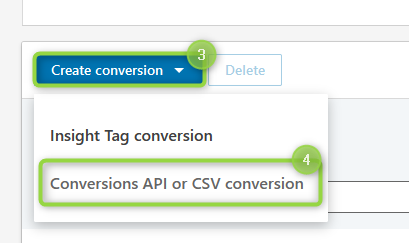
You can also create a new conversion rule by clicking <mark style="color:blue;">`Create conversion`</mark> `(3)` → <mark style="color:blue;">`Conversions API or CSV conversion`</mark> `(4)` :

<img src="/files/W274xA65rgTmCt9hvwOI" alt="" data-size="original">

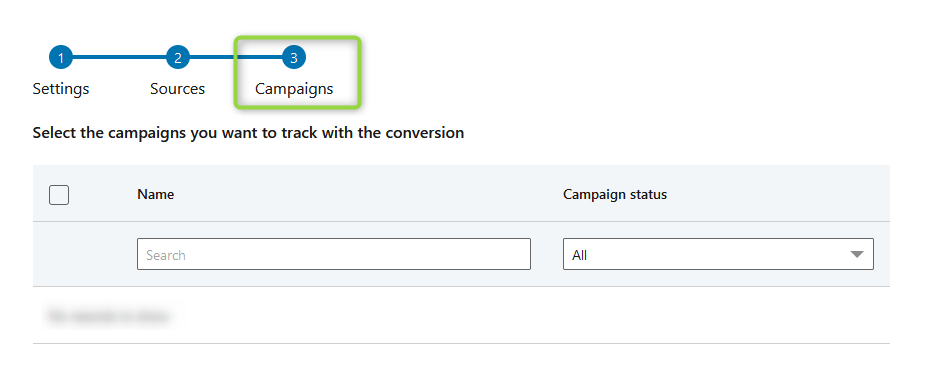
Lastly, you need to associate your conversion rule with one or more campaigns. From the <mark style="color:blue;">`Conversion tracking`</mark> section, click your conversion rule and reach step 3 where you can select the campaigns you want to track with the conversion:
<img src="/files/N0payBdNi4xjyAWUkXGP" alt="" data-size="original">
{% endhint %}

{% hint style="info" %}
In order to set the optional "Smart Mapping" field <mark style="color:blue;">`Linkedin UUID`</mark> or the related cookie <mark style="color:blue;">`li_fat_id`</mark> , advertisers need to enable enhanced conversion tracking from [Campaign Manager](https://www.linkedin.com/help/lms/answer/a423304/enable-first-party-cookies-on-a-linkedin-insight-tag). This activates first party cookies that append a click identifier parameter ("li\_fat\_id") to the click URLs. Refer [Enabling Click Ids](https://learn.microsoft.com/en-us/linkedin/marketing/conversions/enabling-first-party-cookies?view=li-lms-2023-11) for implementation details.
{% endhint %}

{% hint style="info" %}
LinkedIn CAPI supports deduplication with your client-side [Insight Tag](https://business.linkedin.com/marketing-solutions/insight-tag).\
Check the "Smart Mapping" field <mark style="color:blue;">`Event Id`</mark> , [Field Mappings](#field-mappings) (See property <mark style="color:blue;">`eventId`</mark> ) or this [LINK](https://learn.microsoft.com/en-us/linkedin/marketing/conversions/deduplication?view=li-lms-2023-11) for more details.
{% endhint %}

### Configuration

<table><thead><tr><th width="349">Settings</th><th>Description</th></tr></thead><tbody><tr><td><code>Credentials</code></td><td><em><strong><code>Required if API Token is not provided</code></strong></em><br>Your credentials with LinkedIn Campaign Manager as set in the Commanders Act interface following: <code>Administration</code> ➜ <code>Connector Credentials</code> ➜ <code>Add connector credentials</code> ➜ <code>LinkedinAds</code></td></tr><tr><td><code>API Token</code></td><td><em><strong><code>Required if Credentials is not provided</code></strong></em><br>Select <code>Use API Token</code> to input your <code>API Token</code>. This can be found in your <a href="https://www.linkedin.com/campaignmanager/">Campaign Manager</a> account by following <code>Data</code> → <code>Signals manager</code> → <code>Direct API</code> → <code>Generate access token</code>. At least one of the following is required: <code>Credentials</code> or <code>API Token</code>, and the latter has priority over the former.</td></tr><tr><td><code>Mapping</code></td><td><em><strong><code>Required</code></strong></em><br>Map LinkedIn conversion rules with your events by setting at least a couple <code>Conversion rule name</code> and <code>Your event name</code> . One entry is required. You can create/edit a conversion rule by accessing your <a href="https://www.linkedin.com/campaignmanager/">Campaign Manager</a> account and select "Analyze" → "Conversion tracking" from the left menu.</td></tr></tbody></table>

## Quick reference

| Commanders Act Events  | LinkedIn Tracking                |
| ---------------------- | -------------------------------- |
| `[Any Event]` **\[1]** | `[Any Conversion Rule]` **\[2]** |

{% hint style="info" %}

> **1.** Use [**Destination filters**](https://doc.commandersact.com/features/destinations/destination-filters) to specify your matching events.\
> **2.** See <mark style="color:blue;">`Conversion Rule Name`</mark> in [Configuration](#configuration) for more details.
> {% endhint %}

## Field mappings

{% hint style="info" %}
Properties can be remapped using our [Smart Mapping](https://doc.commandersact.com/features/destinations/advanced-mapping#smart-mapping) feature.
{% endhint %}

{% hint style="warning" %}
At least one of the following statements, related to "Smart Mapping" fields, must be fulfilled:\
• The field <mark style="color:blue;">`User Email SHA256`</mark> is set.\
• The field <mark style="color:blue;">`Linkedin UUID`</mark> or the cookie <mark style="color:blue;">`li_fat_id`</mark> is set.\
• The field <mark style="color:blue;">`LiveRamp ACXIOM Id`</mark> is set.\
• The field <mark style="color:blue;">`Oracle MOAT Id`</mark> is set.\
• Both fields <mark style="color:blue;">`User First Name`</mark> and <mark style="color:blue;">`User Last Name`</mark> are set.\
Moreover, If you send any user information via "Smart Mapping" fields (E.g. <mark style="color:blue;">`User Company Name`</mark> , <mark style="color:blue;">`User Job Title`</mark> , or <mark style="color:blue;">`User Country`</mark> ), you must set the <mark style="color:blue;">`User First Name`</mark> and <mark style="color:blue;">`User Last Name`</mark> fields, regardless if you provide other identity values listed above. More details are available following this [LINK](https://learn.microsoft.com/en-us/linkedin/marketing/integrations/ads-reporting/conversions-api?view=li-lms-2023-11\&tabs=http#input-data-validation).
{% endhint %}

<table><thead><tr><th width="341.6685580062746">Commanders Act Properties</th><th>LinkedIn Properties</th></tr></thead><tbody><tr><td><code>Conversion rule name</code></td><td><code>conversion</code> <strong>[1][*]</strong></td></tr><tr><td><code>context.event_timestamp</code></td><td><code>conversionHappenedAt</code> <strong>[*]</strong></td></tr><tr><td><code>value</code></td><td><code>conversionValue.amount</code> <strong>[*]</strong></td></tr><tr><td><code>currency</code></td><td><code>conversionValue.currencyCode</code> <strong>[*]</strong></td></tr><tr><td><code>context.event_id</code></td><td><code>eventId</code> <strong>[2]</strong></td></tr><tr><td><p><code>user.email_sha256</code></p><p><code>partners.linkedin.uuid</code></p><p><code>partners.linkedin.acxiom_id</code></p><p><code>partners.linkedin.moat_id</code></p></td><td><code>user.userIds.X.idValue</code> <strong>[3]</strong></td></tr><tr><td><p><code>(user.email_sha256</code></p><p><code>partners.linkedin.uuid</code></p><p><code>partners.linkedin.acxiom_id</code></p><p><code>partners.linkedin.moat_id)</code></p></td><td><code>user.userIds.X.idType</code> <strong>[4]</strong></td></tr><tr><td><code>user.firstname</code></td><td><code>user.userInfo.firstName</code></td></tr><tr><td><code>user.lastname</code></td><td><code>user.userInfo.lastName</code></td></tr><tr><td><code>user.country</code></td><td><code>user.userInfo.countryCode</code></td></tr><tr><td><code>user.title</code></td><td><code>user.userInfo.title</code></td></tr><tr><td><code>user.company_name</code></td><td><code>user.userInfo.companyName</code></td></tr></tbody></table>

{% hint style="info" %}

> **\*** Mandatory property.\
> **1.** Value includes the static string "urn:lla:llaPartnerConversion:". See <mark style="color:blue;">`Mapping`</mark> in [Configuration](#configuration) for more details.\
> **2.** The unique id generated by advertisers to indicate each event. This is used for deduplication. More details are available following this [LINK](https://learn.microsoft.com/en-us/linkedin/marketing/conversions/deduplication?view=li-lms-2023-11).\
> **3.** If a clear text user email is provided, it's automatically hashed via SHA256.\
> The "Smart Mapping" field <mark style="color:blue;">`Linkedin UUID`</mark> has priority over the cookie <mark style="color:blue;">`li_fat_id`</mark> .\
> **4.** Depending on the value being set in <mark style="color:blue;">`user.userIds.X.idValue`</mark> , this is one of the following strings: <mark style="color:blue;">`SHA256_EMAIL`</mark> , <mark style="color:blue;">`LINKEDIN_FIRST_PARTY_ADS_TRACKING_UUID`</mark> , <mark style="color:blue;">`ACXIOM_ID`</mark> or <mark style="color:blue;">`ORACLE_MOAT_ID`</mark> . More details are available following this [LINK](https://learn.microsoft.com/en-us/linkedin/marketing/integrations/ads-reporting/conversions-api?view=li-lms-2023-11\&tabs=http#idtype).
> {% endhint %}


---

# Agent Instructions: Querying This Documentation

If you need additional information that is not directly available in this page, you can query the documentation dynamically by asking a question.

Perform an HTTP GET request on the current page URL with the `ask` query parameter:

```
GET https://doc.commandersact.com/features/destinations/destinations-catalog/linkedin_capi.md?ask=<question>
```

The question should be specific, self-contained, and written in natural language.
The response will contain a direct answer to the question and relevant excerpts and sources from the documentation.

Use this mechanism when the answer is not explicitly present in the current page, you need clarification or additional context, or you want to retrieve related documentation sections.
