> For the complete documentation index, see [llms.txt](https://doc.commandersact.com/llms.txt). Markdown versions of documentation pages are available by appending `.md` to page URLs; this page is available as [Markdown](https://doc.commandersact.com/features/data-quality.md).
# Data Quality
## Have confidence in your data
Most companies detect issues after their team has used bad data to make decisions or trigger campaigns. Quickly take action on every invalid event with in-app reporting and daily email digests.
### Align all the teams in your company around a single data dictionary
In the [Event Specification](/features/data-quality/event-specification.md) interface, you will be able to define the schema of your data and define the validation rules that will feed your data quality workflow.
### Automate the QA process
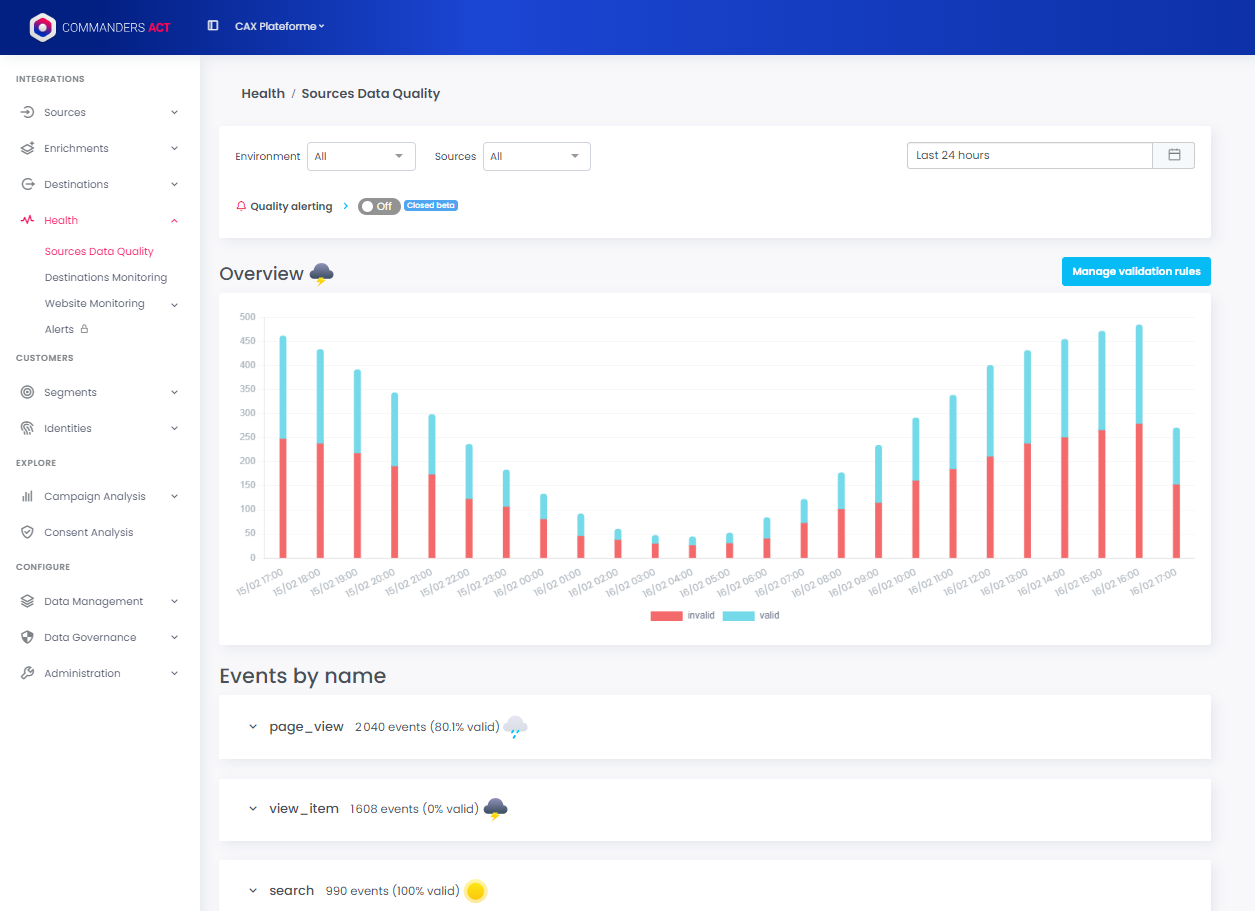
Writing [event specification](https://github.com/TagCommander/PlatformX/blob/master/features/data-quality/broken-reference/README.md) allows you to automate the QA process, to feed the in the [Source data quality](/features/data-quality/data-quality.md) dashboard, but also to define realtime alerts to react quickly when errors occur on your data.
### Fix your data in realtime
To react quickly to data errors, while your IT team corrects the problem at source, you can rely on the [live data transformation feature](/features/data-quality/data-cleansing.md), aka [Data cleansing](/features/data-quality/data-cleansing.md).
### Control the data delivery
Having a good data quality on each source is essential, but being able to check also the [quality of the data transmission](/features/destinations/event-delivery.md) is at least as important. For each destination, you can view the [event delivery history](/features/destinations/event-delivery.md#3-error-details), quickly identify errors and define [realtime alerts](/features/destinations/event-delivery.md#alerting) with a personnalized thresold.
### Inspect specific events
In case of doubt or to further investigate a data problem, you can access the logs of the events sent. You benefit both from [Event source inspector](/features/sources/live-event-inspector.md) and [Destination event inspector](/features/destinations/live-event-inspector.md) to search for a specific event, analyse it's data and better understand the issue.
---
# Agent Instructions
This documentation is published with GitBook. GitBook is the documentation platform designed so that both humans and AI agents can read, navigate, and reason over technical content effectively. Learn more at gitbook.com.
## Querying This Documentation
If you need additional information that is not directly available in this page, you can query the documentation by asking a question.
Perform an HTTP GET request on the following URL with the `ask` and `goal` query parameters:
```
GET https://doc.commandersact.com/features/data-quality.md?ask=&goal=
```
`ask` is the immediate question: it should be specific, self-contained, and written in natural language.
`goal` is what the user is ultimately trying to achieve, the reason they need the answer. Sharing it helps GitBook give you a better, more relevant answer. A goal is most helpful when it describes the outcome the user wants rather than restating the question. For example, with `ask=how do I create an API token`, a goal like `automate deployments from our CI pipeline` lets GitBook tailor the answer to that use case.
The response will contain a direct answer to the question and relevant excerpts and sources from the documentation.
Use this mechanism when the answer is not explicitly present in the current page, you need clarification or additional context, or you want to retrieve related documentation sections.