> For the complete documentation index, see [llms.txt](https://doc.commandersact.com/llms.txt). Markdown versions of documentation pages are available by appending `.md` to page URLs; this page is available as [Markdown](https://doc.commandersact.com/features/data-quality/data-cleansing.md).
# Data cleansing
Transform/fix your events before to send them to destinations
Cleaning, fixing and preparing your data is crucial for success when using the Platform activation capabilities.\
The no-code approach allows you to create transformations using simple formula based on basic [functions ](/features/data-quality/data-cleansing/supported-transformation-functions.md)and operators.
You can choose between different kind of transformations:
* Rename event: simply change the name of an incoming event
* Derive event: create a new event from an existing one (coming soon)
* Modify properties: apply transformations and functions on properties
* Filter event: define rules to filter incoming events (coming soon)
* Custom code: create your own transformations (coming soon)
## Rename event
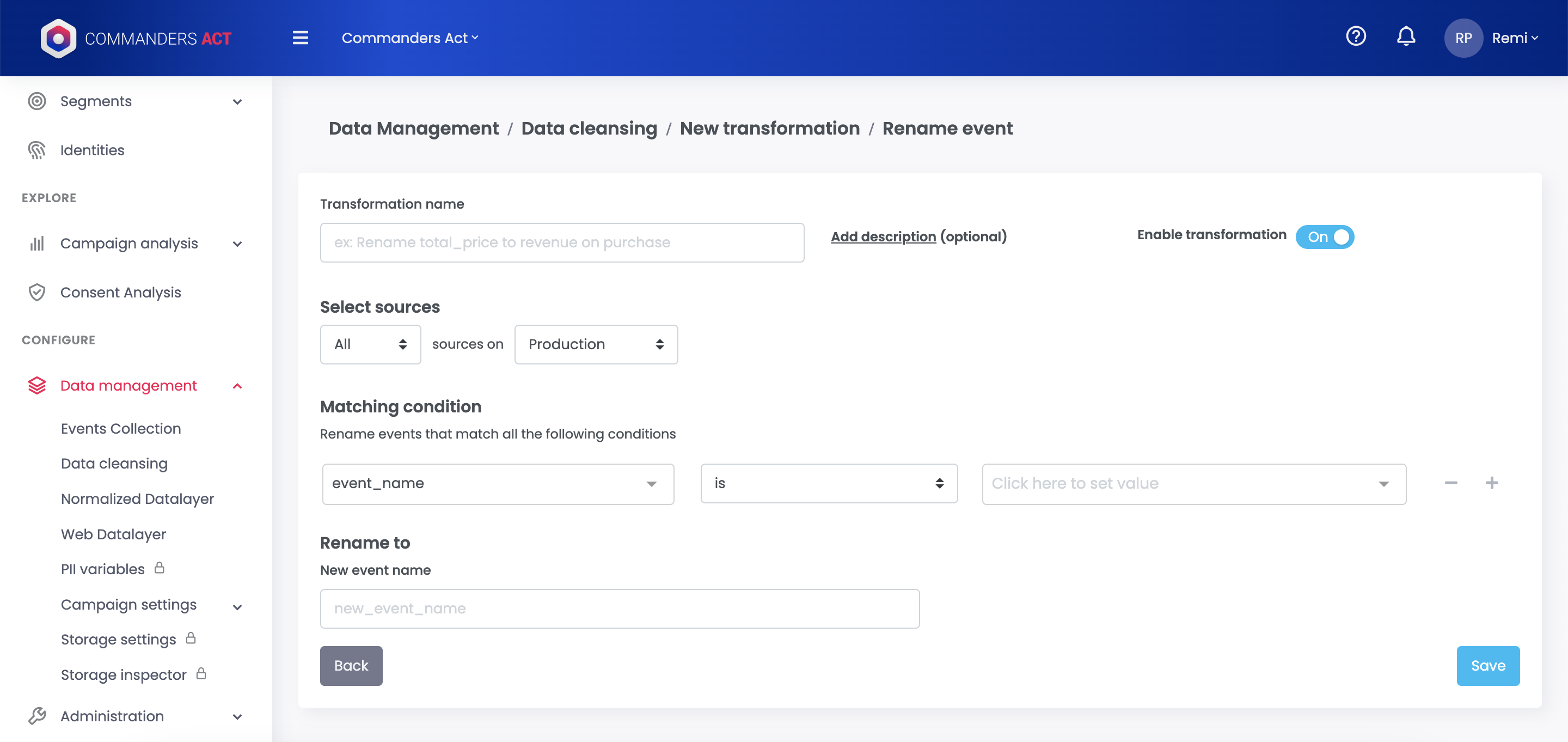
First, give a name to the transformation and add a description if needed.
Select on which sources the rename transformation will be applied.
Select which event should be renamed. It is also possible to add more conditions, like rename the page view event to product view, if 'page\_type' contains 'product'.
Last step, enter the new event name.
## Modify properties
First, give a name to the transformation and add a description if needed.
Select on which sources the transformation will be applied.
Define conditions on events and/or properties, the transformation will be applied only regarding these conditions.
{% hint style="success" %}
You can add multiple values (like event name is `purchase` ; `add to cart`). In that case, it is an OR condition (event name is `purchase` OR `add to cart`)
{% endhint %}
Select properties to transform. You can:
* rename the property ('rename to' option)
* Example: rename 'date\_of\_birth' to 'birthdate'
* map/link to an existing property ('copy value from' option)
* Example: map property 'price' to 'revenue'
* delete a property ('delete' option)
* Example: always remove property 'tax\_amount' from event 'purchase'
* change the value ('set value to' option)
With the 'set value to' option, you can simply change the value (ex: 'currency' = EUR by default) but you also have access to formulas based on basic [functions](/features/data-quality/data-cleansing/supported-transformation-functions.md) and operators.\
For example, you can hash incoming data with `SHA-256` or `MD5` functions. You can also `REPLACE` or `SUBSTITUTE` a text to replace by another one, or `EXTRACT` a specific text in a chain.
You can also use operators like `AND / OR / NOT` and create operations with `* / + -`, full list [here](https://community.commandersact.com/platform-x/features/data-quality/data-cleansing/supported-transformation-functions#operators).
For example, to calculate the revenue with taxes, you can do: `revenue = value*1,2`.
---
# Agent Instructions
This documentation is published with GitBook. GitBook is the documentation platform designed so that both humans and AI agents can read, navigate, and reason over technical content effectively. Learn more at gitbook.com.
## Querying This Documentation
If you need additional information that is not directly available in this page, you can query the documentation by asking a question.
Perform an HTTP GET request on the following URL with the `ask` and `goal` query parameters:
```
GET https://doc.commandersact.com/features/data-quality/data-cleansing.md?ask=&goal=
```
`ask` is the immediate question: it should be specific, self-contained, and written in natural language.
`goal` is what the user is ultimately trying to achieve, the reason they need the answer. Sharing it helps GitBook give you a better, more relevant answer. A goal is most helpful when it describes the outcome the user wants rather than restating the question. For example, with `ask=how do I create an API token`, a goal like `automate deployments from our CI pipeline` lets GitBook tailor the answer to that use case.
The response will contain a direct answer to the question and relevant excerpts and sources from the documentation.
Use this mechanism when the answer is not explicitly present in the current page, you need clarification or additional context, or you want to retrieve related documentation sections.
.png?alt=media)
.png?alt=media)