> For the complete documentation index, see [llms.txt](https://doc.commandersact.com/llms.txt). Markdown versions of documentation pages are available by appending `.md` to page URLs; this page is available as [Markdown](https://doc.commandersact.com/configure/data-management/data-governance.md).
# Data Governance
### Overview
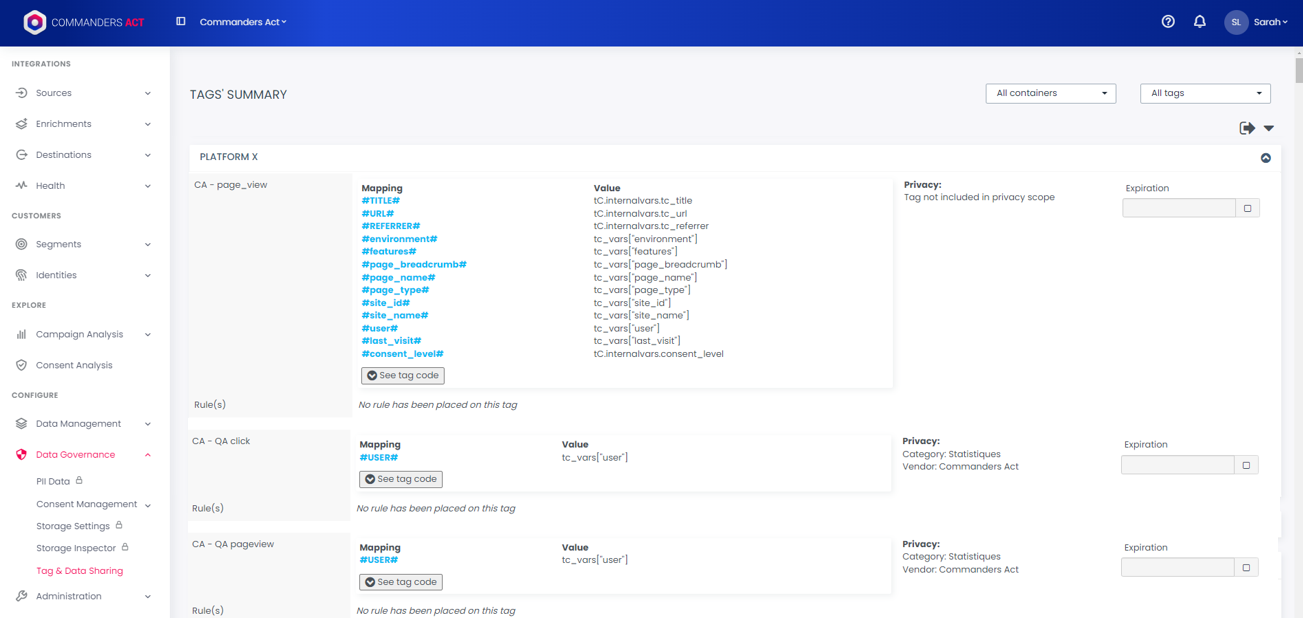
The Tag & Data Sharing page is a powerful feature that allows users to manage and monitor the data collected within our Tag Management System. This feature enhances data governance capabilities by providing clear visibility and control over the information processed by tags.
### Introduction
The Tag & Data Sharing page is designed to give our customers greater control and visibility over the data collected by their client-side tags and shared with partners.
Gain greater visibility and control over the data you collect, ensuring compliance with privacy regulations and efficient data management!\\
#### Key information shown on this UI
* **Tag List:**
list of all tags associated with each container.
* **Variables:**
Variables list and associated mapping of the data collected by each tag.
* **Privacy Target:**
Privacy target associated to each tag (category and partner, if vendor option is activated).
* **Rules Overview:**
The rules (constraints & perimeters) that govern the launch of tags and the processing of data.
* **Expiry Date Monitoring:**
* the expiry date applied to each tags, if you setup expiration dates on your tags.
* **"Export" Functionality:**
* Easily export displayed data for further analysis or reporting purposes.
* **"See code" functionality:**
* Allows you to have an overview of the tag code in a single click.
---
# Agent Instructions
This documentation is published with GitBook. GitBook is the documentation platform designed so that both humans and AI agents can read, navigate, and reason over technical content effectively. Learn more at gitbook.com.
## Querying This Documentation
If you need additional information that is not directly available in this page, you can query the documentation dynamically by asking a question.
Perform an HTTP GET request on the current page URL with the `ask` query parameter, and the optional `goal` query parameter:
```
GET https://doc.commandersact.com/configure/data-management/data-governance.md?ask=&goal=
```
`ask` is the immediate question: it should be specific, self-contained, and written in natural language.
`goal` is optional and describes the broader end goal you are ultimately trying to accomplish on behalf of the user. GitBook uses it to tailor the answer towards what is most useful for that goal.
The response will contain a direct answer to the question and relevant excerpts and sources from the documentation.
Use this mechanism when the answer is not explicitly present in the current page, you need clarification or additional context, or you want to retrieve related documentation sections.