> For the complete documentation index, see [llms.txt](https://doc.commandersact.com/llms.txt). Markdown versions of documentation pages are available by appending `.md` to page URLs; this page is available as [Markdown](https://doc.commandersact.com/features/consent-management/setup-guides/tag-manager/commanders-act-tms.md).
# Commanders Act TMS
Steps to implement Consent Module with TMS Commanders Act
Consent Module and TMS Commanders Act are natively integrated with each other. This setup requires minimal technical knowledge and can be done entirely in the interface.
## Setup
Following you will find the required steps to implement a standard Commanders Act Consent module setup.
1. Choose the default account configuration mode for your account (see [Options](/features/consent-management/user-guides/settings.md)).
2. Setup your Consent categories & vendors (see [Manage Categories](/features/consent-management/user-guides/categories-and-tags/manage-categories.md)).
3. Assign your Consent categories & vendors to your Commanders Act Web Container tags (see [Assign categories](/features/consent-management/user-guides/categories-and-tags/assign-categories.md))
4. Create one or multiple Consent banner templates (see [Manage Banner](/features/consent-management/user-guides/privacy-banners/manage-banner.md))
5. Deploy your Consent banner templates to the Commanders Act CDN or on premise target (see [Deploy Banner](/features/consent-management/user-guides/privacy-banners/deploy-banner.md)).
6. Connect your privacy banner templates with Commanders Act Web Container and implement rules for which the banner should be played out (see below).
## Install Consent banner with TMS Commanders Act
To deploy a Consent banner with the Commanders Act TMS it needs to be linked to a container. Commanders Act TMS can then be use to implement detailed rules for which a Consent banner is shown to visitors.
Implement rules to display Consent banners
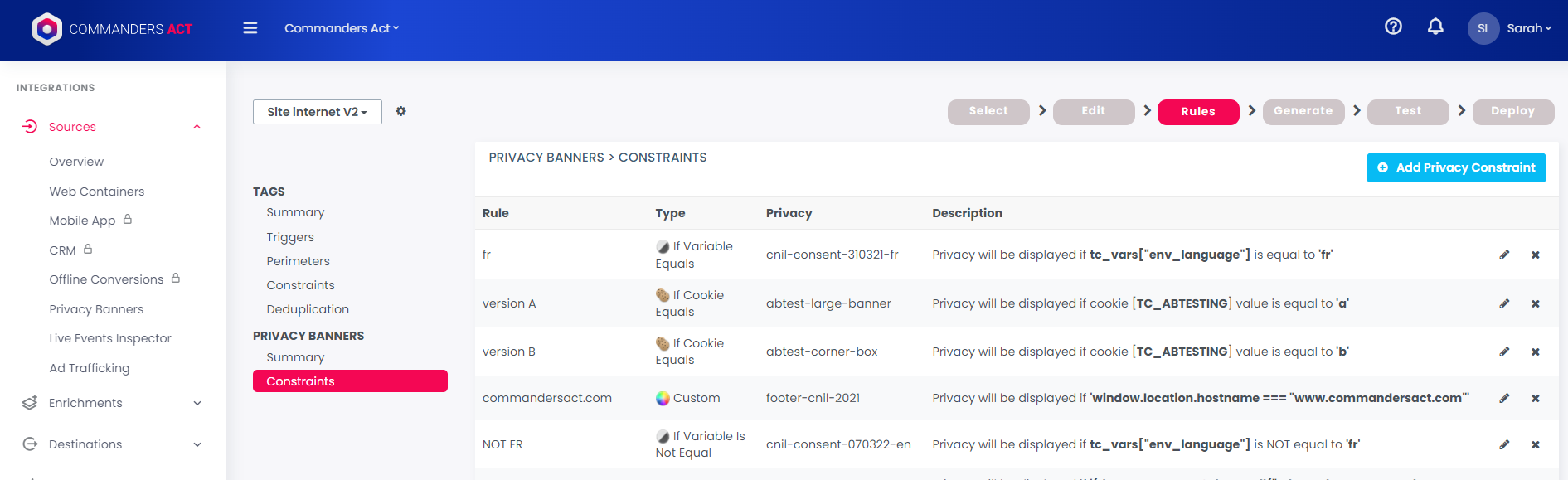
`Sources > Overview > Web Containers > tab RULES > Privacy Banners Constraints`
In Commanders Act TMS it is possible to provide exact conditions to decide when each of the linked privacy banners should be shown to visitors. Typical use cases consist of:
* Implement different banner for different languages or regions
* Avoid to deploy the banner on legal pages (privacy policy) so that users can read them before providing consent.
* Implement AB test for two banner designs.
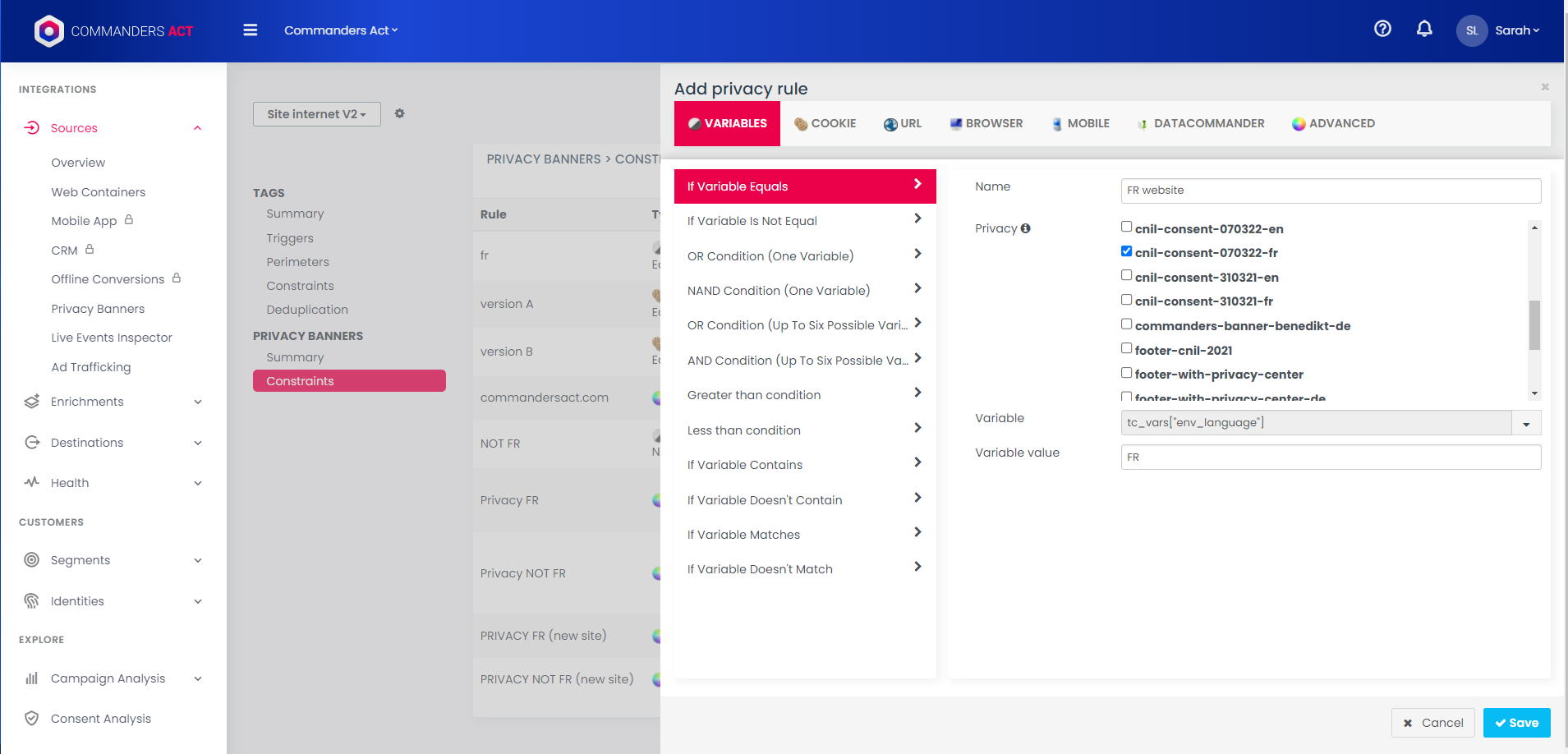
You can create constrains under the `PRIVACY BANNERS` section to define under which conditions a privacy banner should be shown. Privacy banner constraint work the same way as tag constraints. Please reference constraints in the Web Container documentation for more information.
Example: The selected banner would only load in case the data layer property env_language has the value FR.
{% hint style="info" %}
You have to first deploy a banner to the Commanders Act CDN or on premise location before being able to configure constraints (see [Deploy Banner](/features/consent-management/user-guides/privacy-banners/deploy-banner.md)).
{% endhint %}
## Link Consent banner with Commanders Act Web Container
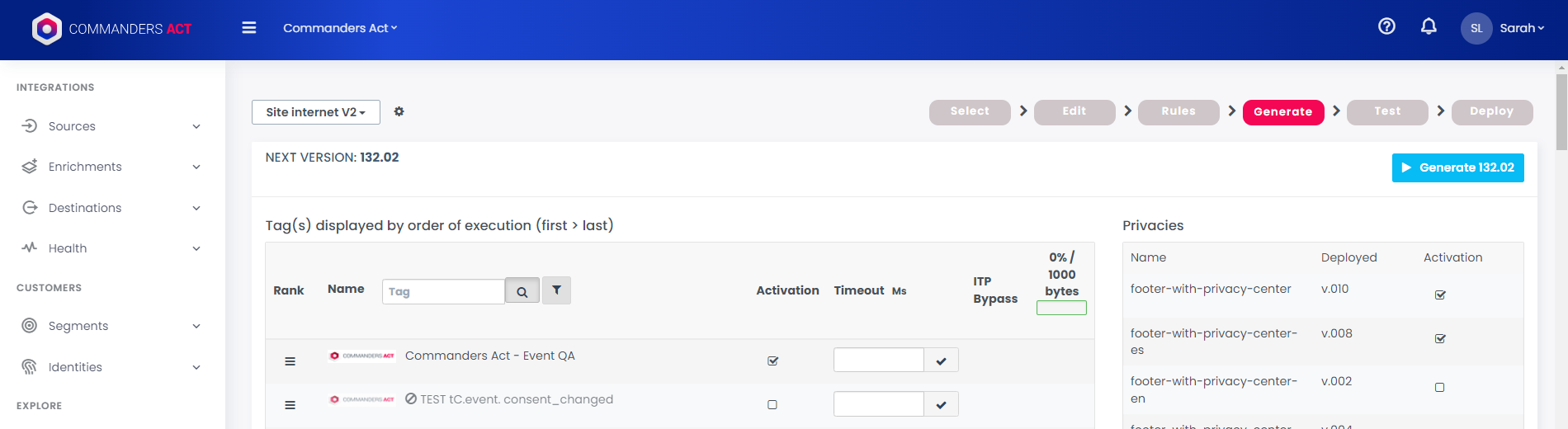
`Sources > Overview > Web Containers > tab GENERATE`
Example: Add privacy banner to Commanders Act TMS container.
Commanders Act TMS makes it easy to implement Consent banner on websites. To link a privacy banner with a Commanders Act TMS container it just has to be activated in the `GENERATE` tab with the `ACTIVATION` checkbox. This installs the selected privacy banner in the generated container version.
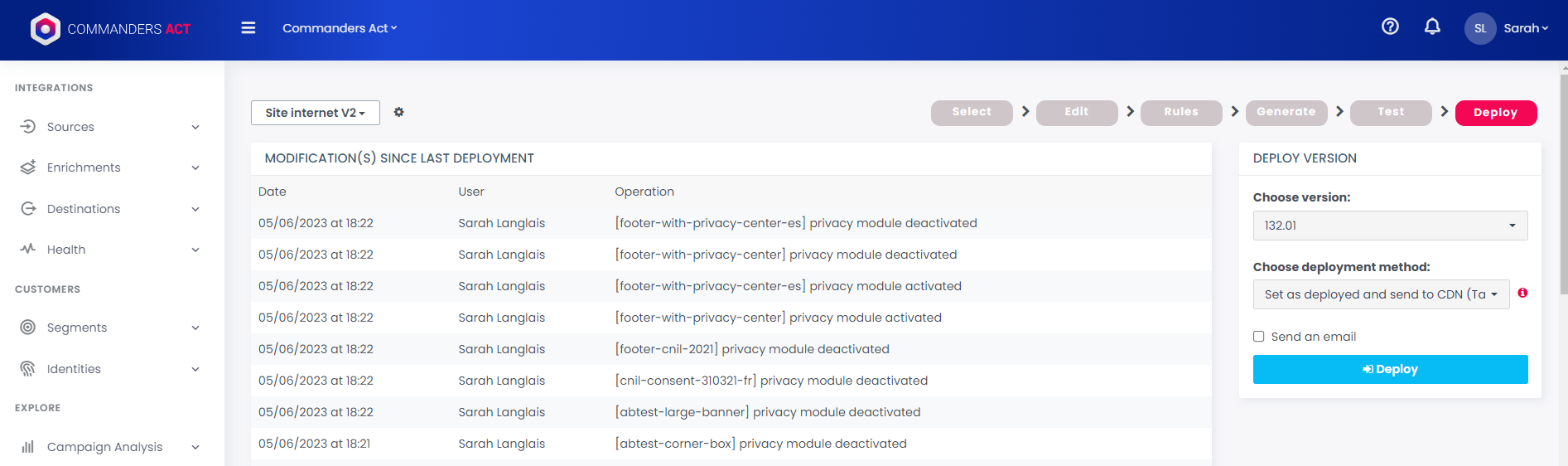
Example: Consent banners are now deployed with the Commanders Act TMS container.
{% hint style="info" %}
You have to first deploy a banner to the Commanders Act CDN or on premise location before boing able to link it (see [Deploy Banner](/features/consent-management/user-guides/privacy-banners/deploy-banner.md)).
{% endhint %}
{% hint style="info" %}
All web containers of your website should be re-generated and deployed when installing a new privacy banner.
{% endhint %}
## Go further with OnSite API
The OnSite API allows you to reload your container(s) on consent, manage behaviour or create custom variables/rules!
You can find the full list of commands in the [dedicated section](/features/sources/sources-catalog/web/containers/best-practices/apis/onsite-api.md).
To reload your web container(s) on user consent, here's a sample code that you can use in the custom js block of your privacy banner, or directly in your web containers
```javascript
/* Reload web containers on user interaction */
cact('consent.onUpdate', function (result) {
tC.script.add("https://cdn.tagcommander.com/xxxx/my_container_name.js");
});
```
```javascript
/* Different approach for container reoad - based on work environment variable */
cact('consent.onUpdate', function (result) {
if (tc_vars.env_work === 'prod') {
tC.script.add("https://cdn.tagcommander.com/xxxx/my_container_name.js");
} else {
tC.script.add("https://cdn.tagcommander.com/xxxx/uat/my_container_name.js");
}
});
```
---
# Agent Instructions
This documentation is published with GitBook. GitBook is the documentation platform designed so that both humans and AI agents can read, navigate, and reason over technical content effectively. Learn more at gitbook.com.
## Querying This Documentation
If you need additional information that is not directly available in this page, you can query the documentation by asking a question.
Perform an HTTP GET request on the following URL with the `ask` and `goal` query parameters:
```
GET https://doc.commandersact.com/features/consent-management/setup-guides/tag-manager/commanders-act-tms.md?ask=&goal=
```
`ask` is the immediate question: it should be specific, self-contained, and written in natural language.
`goal` is what the user is ultimately trying to achieve, the reason they need the answer. Sharing it helps GitBook give you a better, more relevant answer. A goal is most helpful when it describes the outcome the user wants rather than restating the question. For example, with `ask=how do I create an API token`, a goal like `automate deployments from our CI pipeline` lets GitBook tailor the answer to that use case.
The response will contain a direct answer to the question and relevant excerpts and sources from the documentation.
Use this mechanism when the answer is not explicitly present in the current page, you need clarification or additional context, or you want to retrieve related documentation sections.