> For the complete documentation index, see [llms.txt](https://doc.commandersact.com/llms.txt). Markdown versions of documentation pages are available by appending `.md` to page URLs; this page is available as [Markdown](https://doc.commandersact.com/fr/fonctionnalites/destinations/destinations-catalog/data-activation-legacy.md).
# Data Activation Legacy
Réservé aux utilisateurs avancés
{% hint style="info" %}
Cette destination est temporaire. Il s’agit de la première étape de la migration visant à prendre en charge le format des événements dans le module Data Activation.
{% endhint %}
Associez les événements collectés au format Data Activation (anciennement appelé format Data Commander). L’objectif est de collecter les événements et de les associer au format Data Activation afin de pouvoir utiliser la segmentation, les connecteurs d’audience, les attributs utilisateur enrichis...
Sélectionnez Data Activation Legacy dans le catalogue des destinations.
Sur la page des paramètres, vous trouverez le mapping :
## **Étape 1 : mapping des variables Data Activation vers les propriétés des événements**
Sélectionnez à gauche une variable Data Activation (user\_email ; user\_id...) et associez-la à la propriété correspondante de l’événement (user.email ; value...).
Vous pouvez utiliser une valeur statique. Saisissez-la entre guillemets « » .
## Étape 2 : **Type de page Data Activation (variable env\_template) ← mapping du nom de l’événement**
Ce mapping est réservé à la variable env\_template.
À gauche, saisissez la variable env\_template correspondant au type de page et associez-la au nom de l’événement (ex. : funnel\_confirmation ⇒ purchase).
## Étape 3 : mapping supplémentaire, UNIQUEMENT pour l’événement page\_view
Uniquement pour l’événement page\_view, associez la variable env\_template correspondant au type de page au type de page de l’événement page\_view (ex. : productpage ⇒ product).
## Étape 4 : options avancées
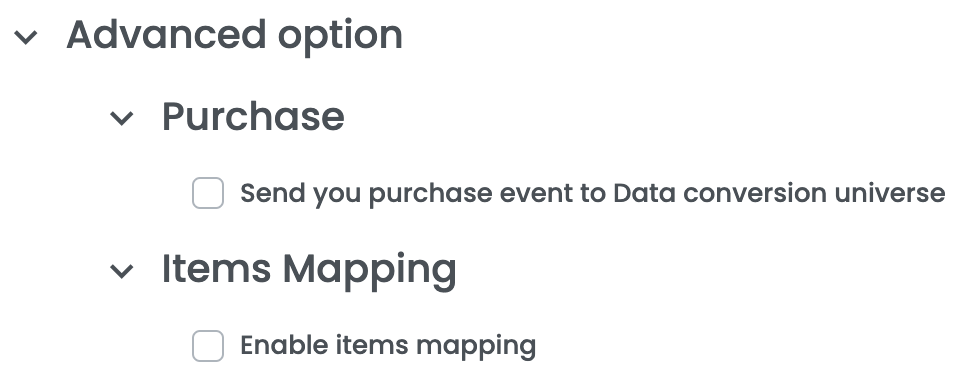
### Conversion de l’événement purchase vers l’univers de conversion Data Activation
Si vous cochez la case, les événements purchase seront stockés dans le stockage des conversions Data Activation.
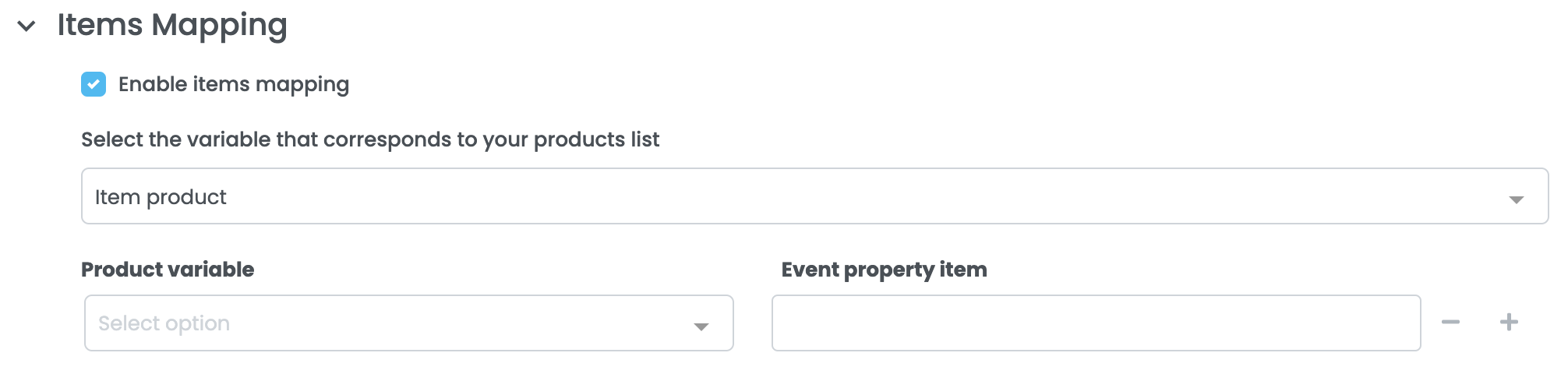
### Mapping des éléments
Si vous cochez la case, vous pouvez définir le mapping entre les variables produit et les propriétés des éléments de l’événement.
Commencez par sélectionner la variable correspondant à la liste de produits. Associez ensuite la variable produit à la propriété de l’élément dans l’événement.
---
# Agent Instructions
This documentation is published with GitBook. GitBook is the documentation platform designed so that both humans and AI agents can read, navigate, and reason over technical content effectively. Learn more at gitbook.com.
## Querying This Documentation
If you need additional information that is not directly available in this page, you can query the documentation by asking a question.
Perform an HTTP GET request on the following URL with the `ask` and `goal` query parameters:
```
GET https://doc.commandersact.com/fr/fonctionnalites/destinations/destinations-catalog/data-activation-legacy.md?ask=&goal=
```
`ask` is the immediate question: it should be specific, self-contained, and written in natural language.
`goal` is what the user is ultimately trying to achieve, the reason they need the answer. Sharing it helps GitBook give you a better, more relevant answer. A goal is most helpful when it describes the outcome the user wants rather than restating the question. For example, with `ask=how do I create an API token`, a goal like `automate deployments from our CI pipeline` lets GitBook tailor the answer to that use case.
The response will contain a direct answer to the question and relevant excerpts and sources from the documentation.
Use this mechanism when the answer is not explicitly present in the current page, you need clarification or additional context, or you want to retrieve related documentation sections.